Some months ago, my children did not know Bluebeard. I told them the tale, making it as spooky as possible. Dinner-time talk is a struggle. None of my children can reliably respond to “how was your day?” in a convivial manner. Before our heroine opened the forbidden door, I paused dramatically. Around the table, six sets of eyes peered back at me; a rapt silence held.
Fairy tales are powerful. Many of us know at least one or two. In a pinch (“tell me a stooooooooooooory”), we could tell them from memory. They hold lasting power over the listener as well. Days later, my kids were still talking about the meaning of Bluebeard.
Fairy tales get smeared as “morality tales.” No one likes a lecture. Stories that foist a message on readers are often unsuccessful.
Fairy tales are complex. They often feature good and bad guys. Someone always pays a price. Justice in Fairyland is weird, though. The rules are laid out clearly but often seem arbitrary (“never look in this closet”). Characters can win through playing tricks. Sometimes the heroes and heroines get an unjust end. Close readers of fairy tales and close observers of children will spy some similarities here. That’s the power of fairy tales: they say something real about children’s lives, as they are, right now.
Mac Barnett’s retelling of Rumpelstiltskin stays true to the form while making some much-needed updates to the original tale. The three most important updates are (1) centering the daughter as the main character, (2) adding humor, and (3) rewriting Rumpelstiltskin’s song.
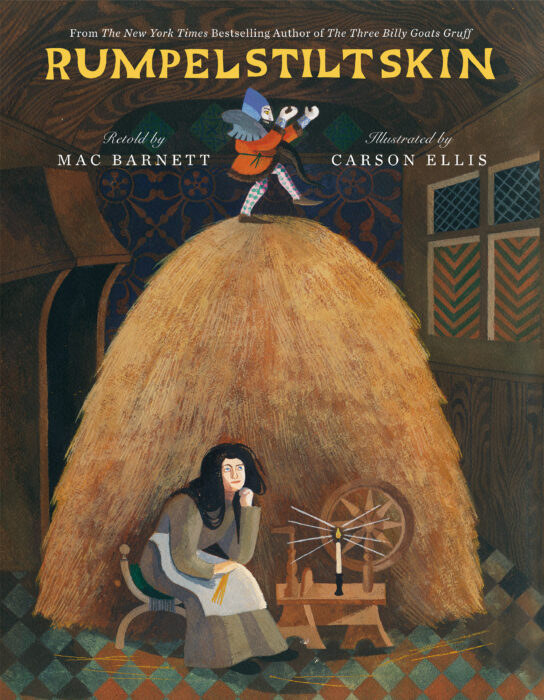
Here is the opening of a 1944 version of Rumpelstiltskin from The Complete Grimm’s Fairy Tales: “Once there was a Miller who was poor but who had a beautiful daughter.”
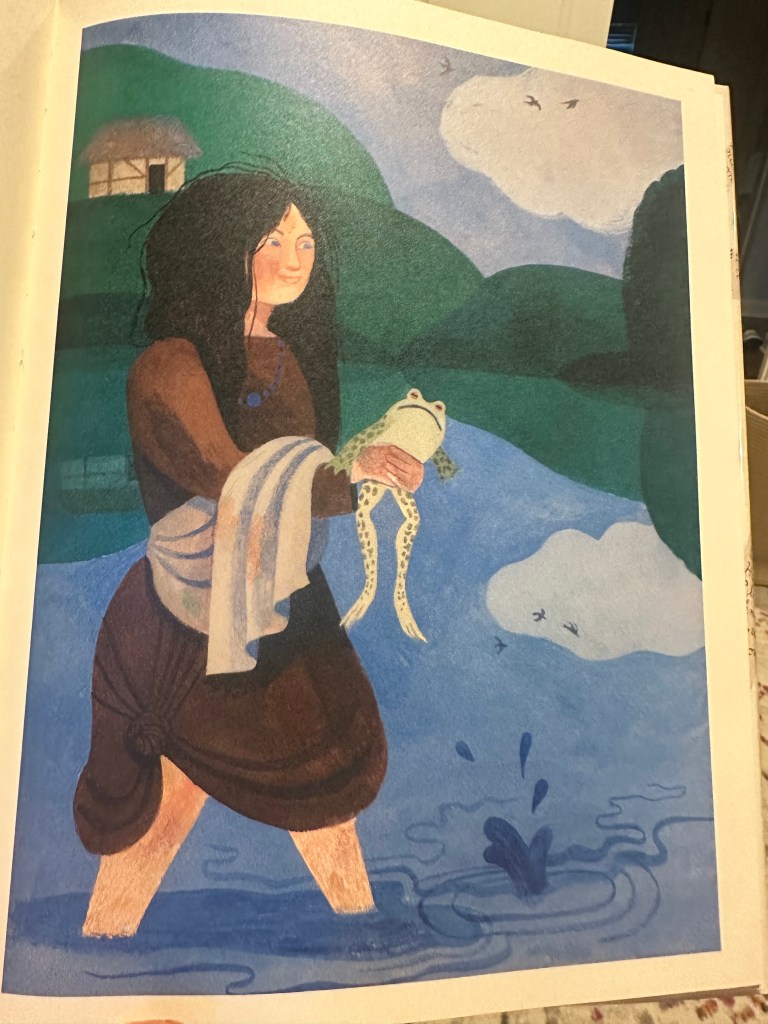
Here is Barnett’s opening: “Once upon a time a girl grew up in the woods, climbing trees and whittling sticks and catching tadpoles with her bare hands.”
There she is. Even without Carson Ellis’ excellent illustrations (gouache on cold-press watercolor paper), can you see her in all her movement and glory?
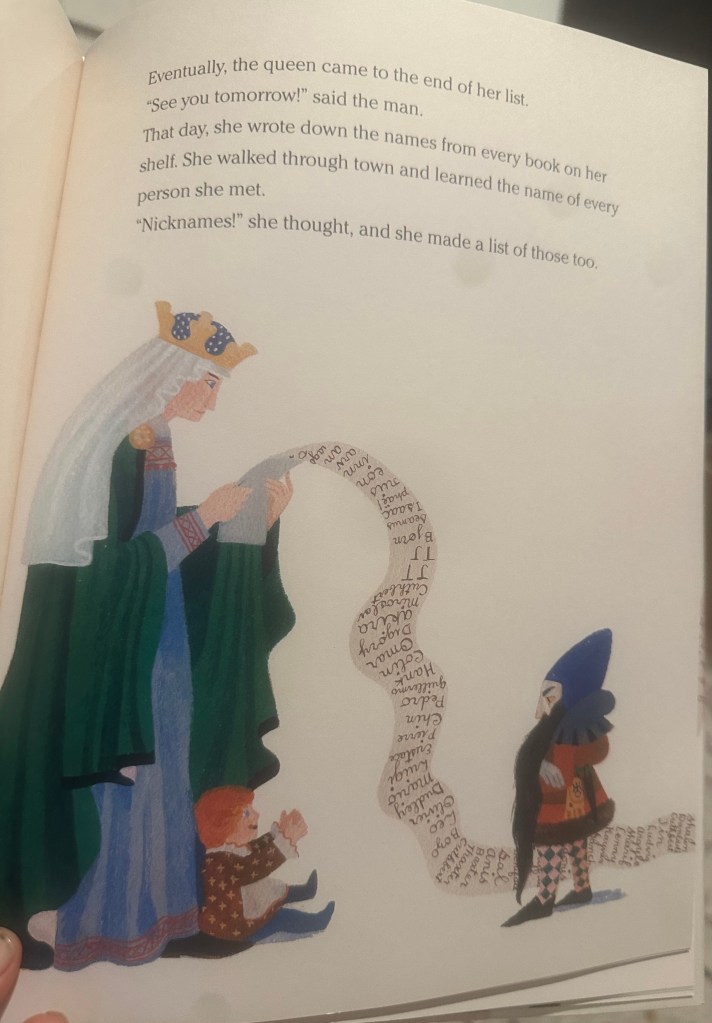
In the 1944 version, the girl (now the Queen) has a single paragraph where she guesses names. She takes a stab at three “most uncommon and curious.” In Barnett’s version, the guessing goes on for multiple pages with several humorous moments (trying Tom after Thomas is a no-go, trying Thaxter after Baxter, and even trying Mac). This is a retelling that knows its audience. Listeners will be giggling as the Queen runs through her list.
The older version of Rumpelstiltskin has the trickster dancing around the fire and singing to himself: “To-day I bake, to-morrow brew/The next I’ll have the young Queen’s child/Ha! glad am I that no one knew/That Rumpelstiltskin I am styled.” Aside from the old-timey language, try reading that aloud with rhythm
Now try Barnett’s version: “Tomorrow I’ll feast. Tonight I dance!/I gave that lady every chance/to keep her child, but now he’s mine!/And though the queen will cry and whine,/she’s no one but herself to blame,/and Rumpelstiltskin is my name!”
Fairy tales are part of the oral tradition of storytelling. School Library Journal recently recommended the audiobook version of Barnett’s Rumpelstiltskin. I have no doubt that it’s excellent. It would suffice. It would also be missing the magic of Ellis’ illustrations.
The illustrations evoke block printing, an old-fashioned style that pairs well with an old tale. Ellis’ composition choices are excellent. Rumpelstiltskin is often placed on the far right side of the page, which gives readers the sense we are viewing the moment he enters the room and conveys the girl’s/queen’s surprise at seeing him. Ellis depicts Rumpelstiltskin appearing on the page via increasingly strange means (the door, then a trapdoor in the floor, then through the lit fire). This conveys the queen’s growing unease with this huckster.
And then there is the best page in the book: a cinematic close-up at the moment when the Queen bests the trickster.
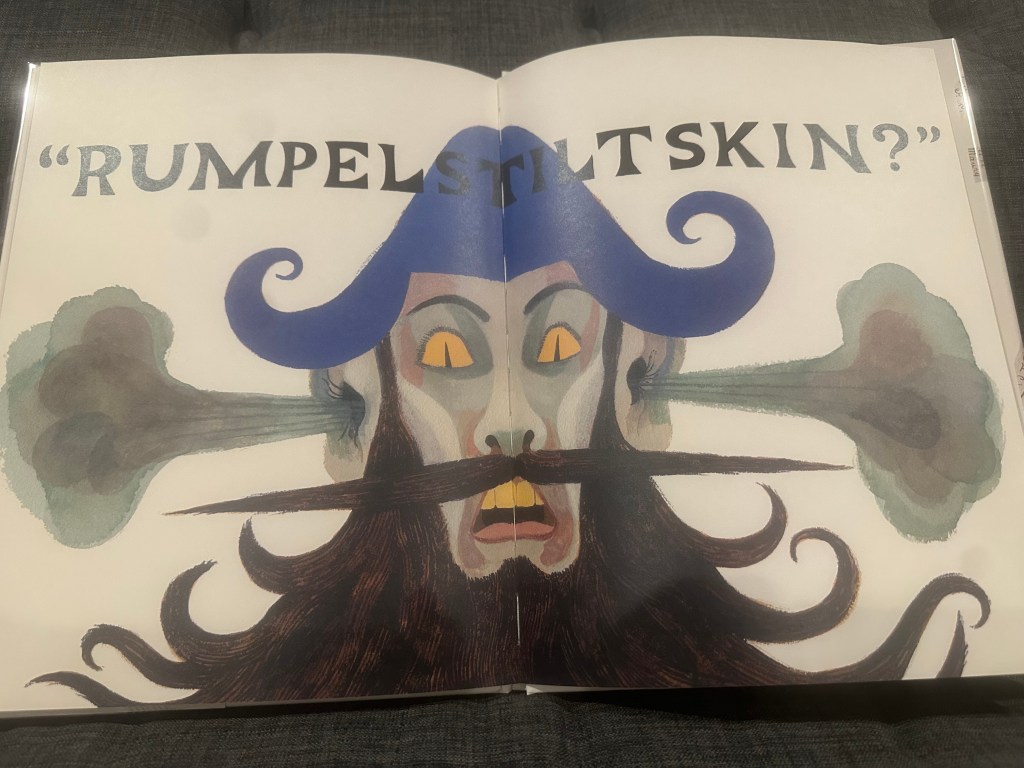
This book is a feast for the ears and eyes.
Educators’ Corner
Educators will teach fairy tales as part of the standard Reading Literary Texts (Key Ideas and Plot Details, Craft and Style, and Integration of Concepts) (K – 3rd grade). Because fairy tales have multiple versions, educators can use them to compare and contrast texts.

