Author studies examine one author’s work using multiple sources. Author studies are undertaken by a whole class, small group, or even just the educator. These studies pack in multiple opportunities to explore reading, writing, and critical thinking. They expose learners to both literary and information texts. They deepen our reading while providing an opportunity to delve into the craft of writing.
For a summary look at how an Author Study can be used to meet the Virginia Standards of Learning and classroom management goals, please see the Educator Corner section below.
About the Author
Educators can teach students to begin with the author website. They will see a picture of the author and read biographical information.
The back cover of books usually includes an “About the Author” section. Special tip: the older the book, the more likely the “About the Author” section will include biographical details. Newer books’ About the Author section often focus on other books by the author.
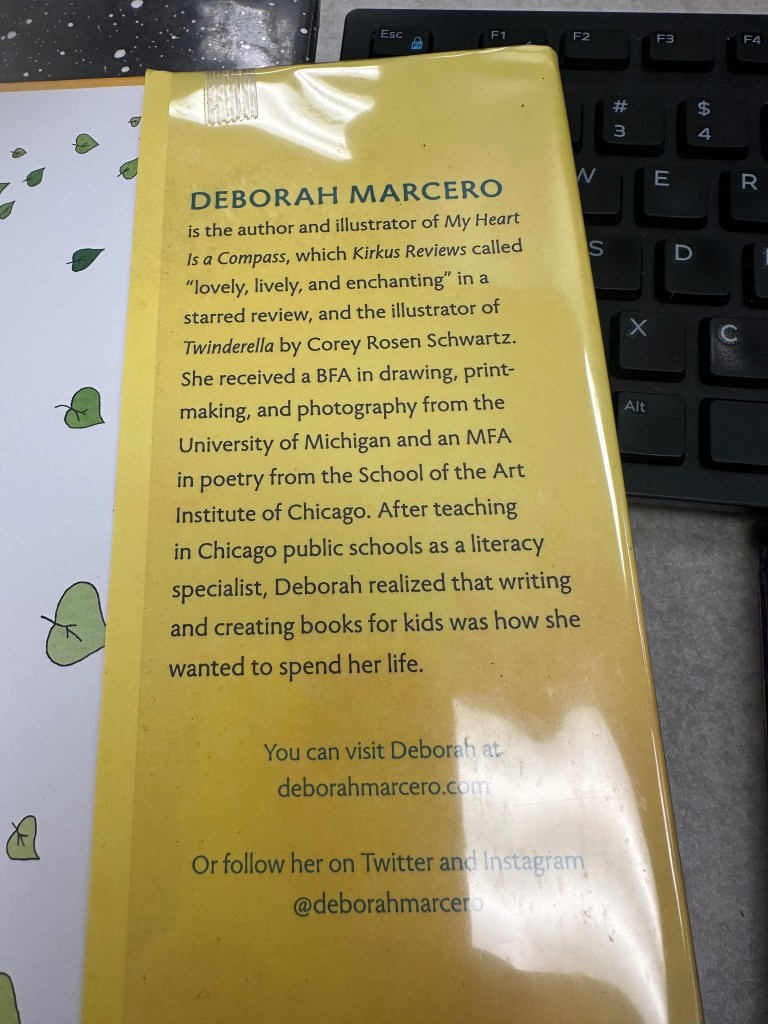
Author websites are also a great source to find contact information for the author, which can be used for letter writing projects.
Author Interviews or Speeches and Essays
Interviews allow students to hear from the author directly, learn more about their process, and become inspired by their commitment to writing for children. For educators, reading interviews prior to teaching a book can allow for a deeper reading of the work — a reading informed author intention and their knowledge of craft.
The website Cynsations published Mitu Malhotra’s interview with Marcero on her newest book The Great Escape. Marcero says “What allows me to have hope in the face of it all, is that I know publishers, readers, librarians, kid-lit enthusiasts are always looking for a book that will touch their hearts. Readers are hungry for stories that make them feel a little changed after they read them. And this is my life’s work now.”
Investigate if the author has been interviewed on a podcast or on YouTube. Exploring audio formats of author interviews increases the accessibility of this informational format. It allows students to connect with the literal voice of the author.
Nick Patton interviewed Marcero about In a Jar for his podcast Picturebooking. Listening to this podcast episode allowed me to learn more about Marcero’s background and process. It gave me ideas for how to connect In a Jar with a science lesson on direct observation and brought to light the books’ connection to the genre of magic realism.
Marcero on Magic Realism:
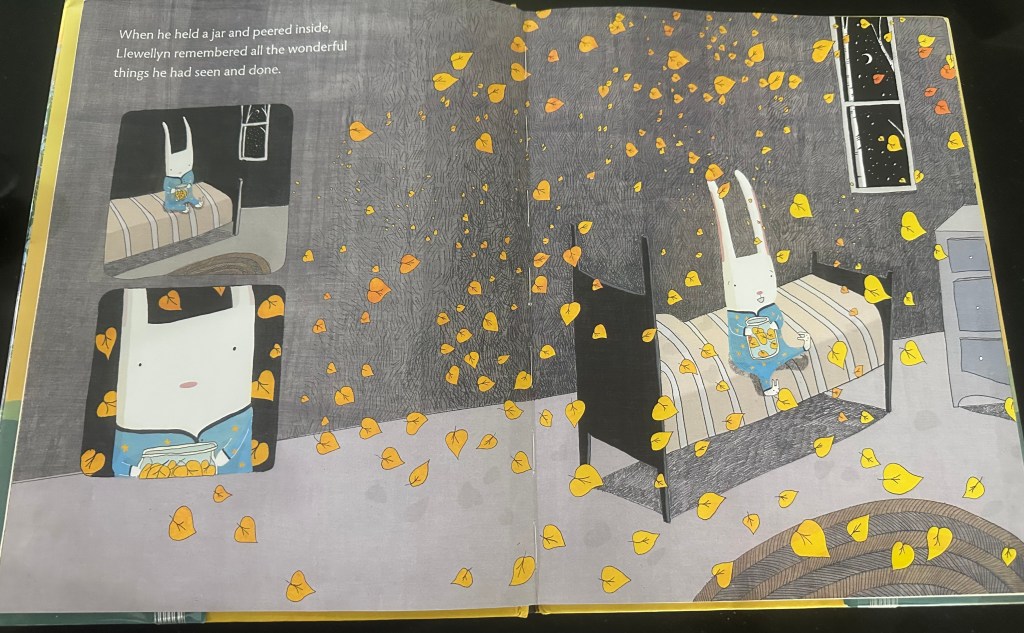
Direct observation:
Book Reviews
Students and educators can examine the difference between professional book reviews from reputable sources versus those on GoodReads, Audible, or other non-vetted sources.
School Library Journal, Publishers’ Weekly, Horn Book, Kirkus, and the The Bulletin of the Center for Children’s Books are all excellent, reputable sources to read book reviews and occasionally author interviews.
In addition to comparing professional reviews to non-professional reviews, students could try their own hand at a book review or book talk for one of the author’s books.
The Books
All this before we even have gotten to the books! When conducting an author study, I recommend beginning with at least one of the authors books as a read aloud or a close examination of a single page, quote, or illustration.
If you cannot find an author’s books in your school or public library, online read-alouds are another way to experience those books.
Here’s a playlist of read-alouds of Marcero’s books. Playlists are great in calm moments in classrooms at home. (Or moments where you wish for calm.) These read-alouds can project for “settling in” time when learners enter a space and transition into quieter moments.
In Donalyn Miller’s excellent book Reading in the Wild, Miller argues that the most important thing we can give to readers is time to read. She writes, “Finding time to read requires commitment, though. I make an effort to carve out reading time because it matters to me.”
Miller acknowledges that students have jam-packed schedules. She teaches her students to read during downtime — waiting in line, when class is interrupted, on the bus, and getting settled into a classroom are all moments that students can use to read.
More educators and administrators are realizing the benefits of “calm down” spaces where students can go to recenter and get ready to re-engage. Setting up these spaces with low-effort reading opportunities through read-alouds is a win-win. If students can not be expected to stay on a single playlist, a read-aloud playlist could still be projected (and therefore controlled by the educator) for students as they settle into their seats.
Let’s take a closer look at five of Deborah Marcero’s books in order of publication.
In a Jar
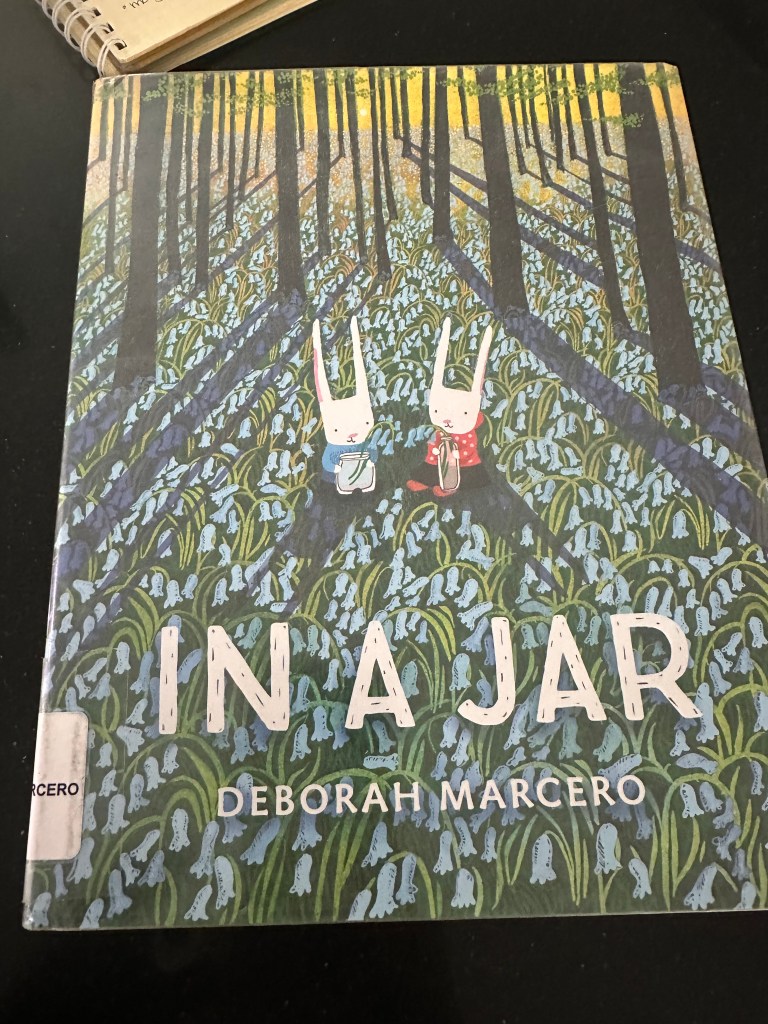
Published 2020
Medium: pencil, water color, ink digital media
In a Jar introduces readers to the character of Llewellyn, who has discovered that he can collect beautiful moments in a jar. Later, he is able to open the jars to savor the memory. Llewellyn meets a good friend, Evelyn, who shares his passion for saving moments in jars. When Evelyn moves away, Llewellyn must discover a way to bridge the distance.
Marcero’s artwork places her characters in landscapes of abundance. Patterns recreate leaves falling or fields full of flowers. The jars, when open, burst forth with keepsakes.
In her interview with Nick Patton, Marcero draws a connection between In a Jar and the magic realism in One Hundred Years of Solitude by Gabriel García Márquez. Older students could return to this picture book as an introduction to the genre of magic realism. Younger students could explore the jars as an example of metaphor.
In a Jar captures the joy of close observation of the natural world. Marcero’s spreads often depict a large landscape alongside her drawing of Llewellyn’s jars, which house the tiny — walking a path a forest of falling leaves versus a handful of the leaves. Readers could explore the activity of quiet observation outside, at a window, or even in their own classroom to collect moments for their own “jars.”
Llewellyn and Evelyn’s conclusion to their dilemma — that they can mail each other jars — could be an interesting starting point to a unit on letters or cultural exchange. Many cities have sister cities organizations that could assist educators in connecting students from other cultures.
The Boy Whose Head was Filled with Stars: A Life of Edwin Hubble
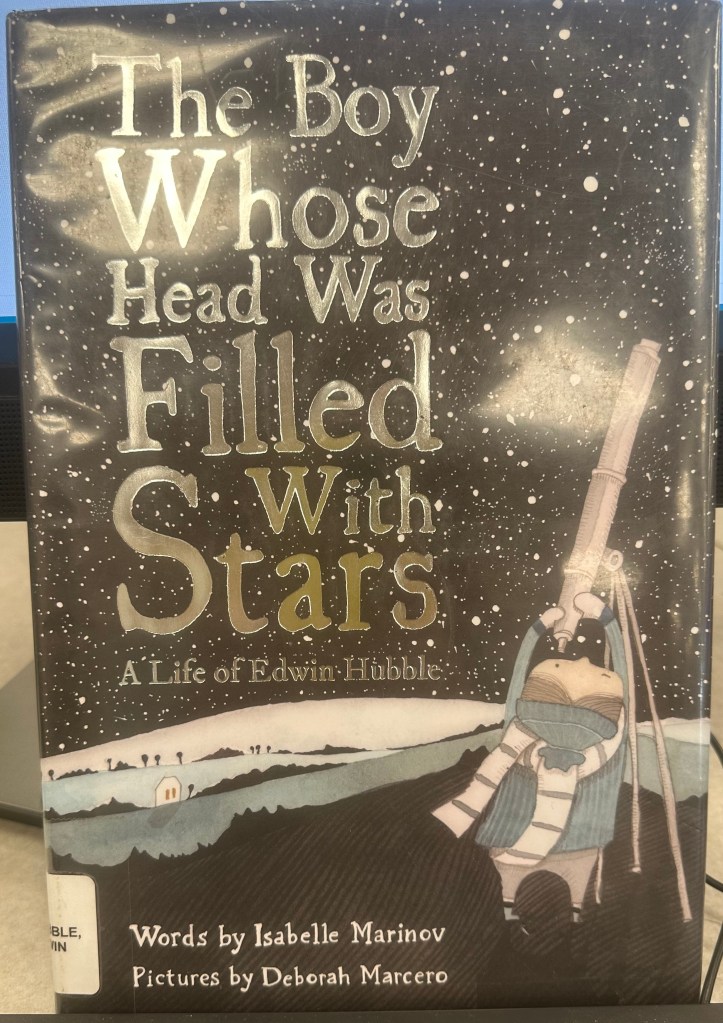
by Isabelle Marinov, illustrated by Deborah Marcero
Published 2021
Medium: hot press water color paper, water color paints, archival ink pens, images from the James Webb Space Telescope and photoshop
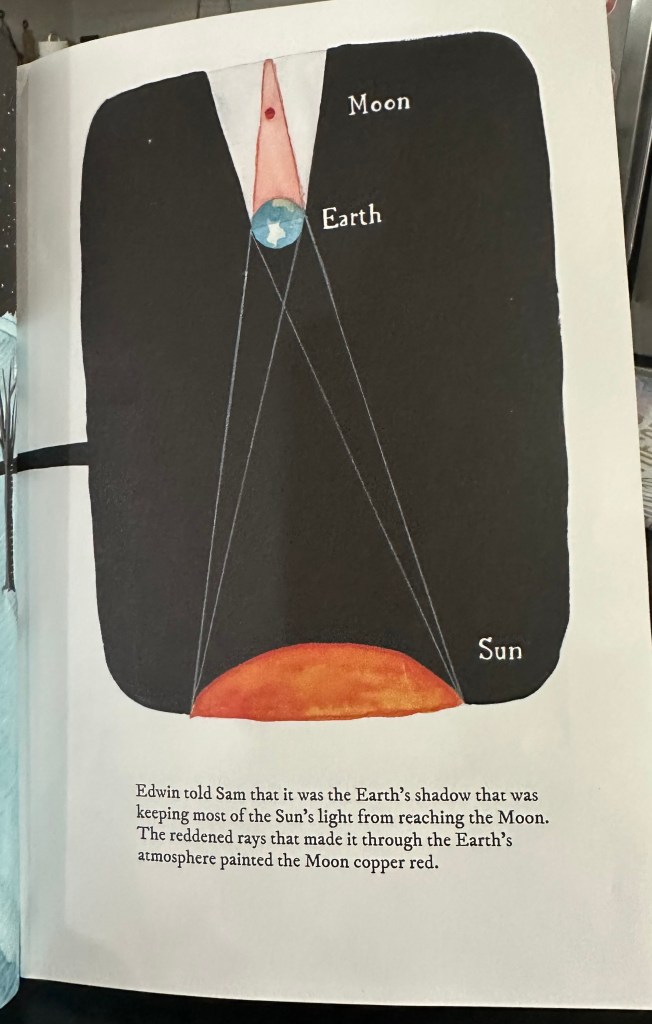
This information picture book introduces readers to the life of Edwin Hubble. Marcero’s illustrations feature expansive skyscapes, fold out pages, and informative drawings.
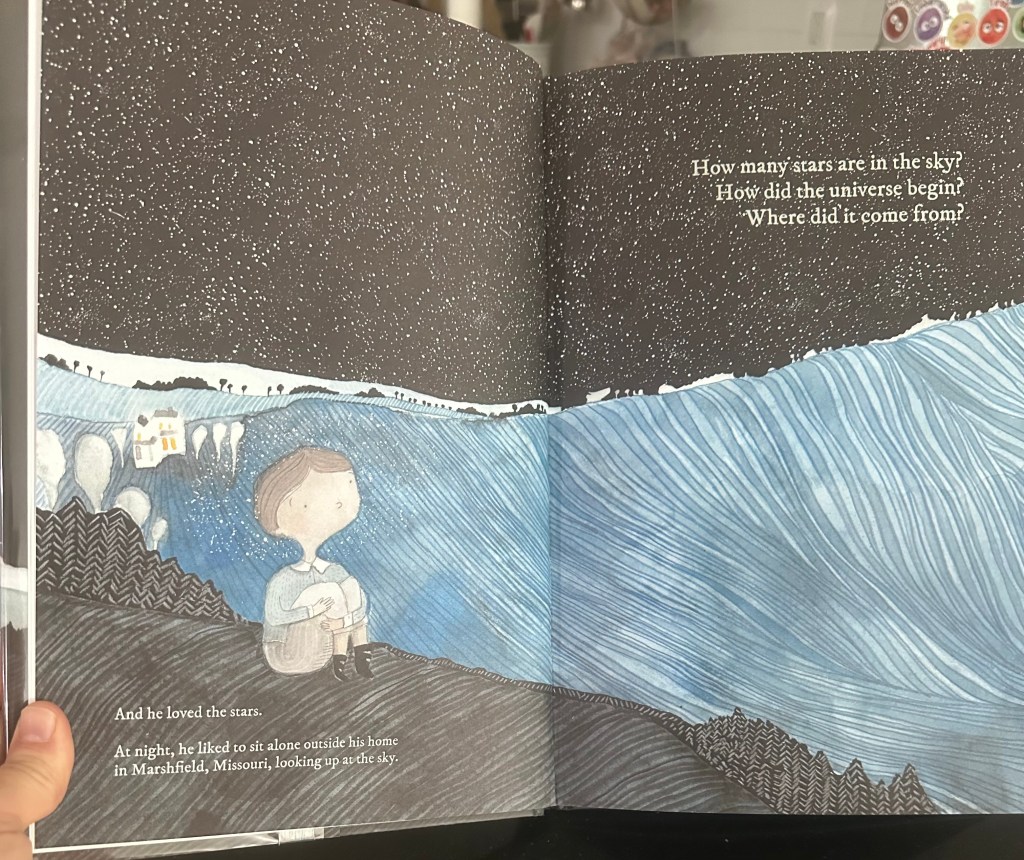
Students can read The Boy Whose Head was Filled With Stars as an introduction to informational texts, specifically biography. As part of your Marcero author study, this book can be used to compare and contrast text and illustrations of fiction and non-fiction works. Educators can use it to discussion the importance of visual images in conveying scientific information. See for example, Marcero’s illuminate illustration of an eclipse.
In her illustrators’ note, Marcero writes, “Embarking on illustrating a historical biography is a task filled with so many questions about small visual details. What did the Milky Way look like to those who lives in the 1900? What kind of clothes would Edwin wear as a child? What did a hand-built telescope look like?” Marcero’s questions invite the reader to expand their notion of what an illustrator does. Students could expand upon this by asking what they would need to research to successfully illustrate a book on a topic of their choosing.
Educator tip: Educators and older students can begin with the author and illustrator notes in the back of information texts. These notes, a form of information text themselves, often provide readers with additional context, interpretive clues, and supplementary reading or sources. Information picture books and the accompanying author notes can be an excellent starting point for learning more about a subject for all ages.
This book would also be an excellent tie in to science lessons on space and space exploration. In addition to introducing a central figure in American astronomy, educators might use the book as a launching point for a Make Your Own telescope project. As Marcero states in her illustrator note, she used James Webb Space Telescope images as part of her artwork for this books. Middle School students might spend time reading about the Hubble Telescope and James Webb Space Telescope after reading this book. Looking at the latest images from the James Webb Space Telescope, can learners spot the images influences on Marcero’s work?
Out of a Jar
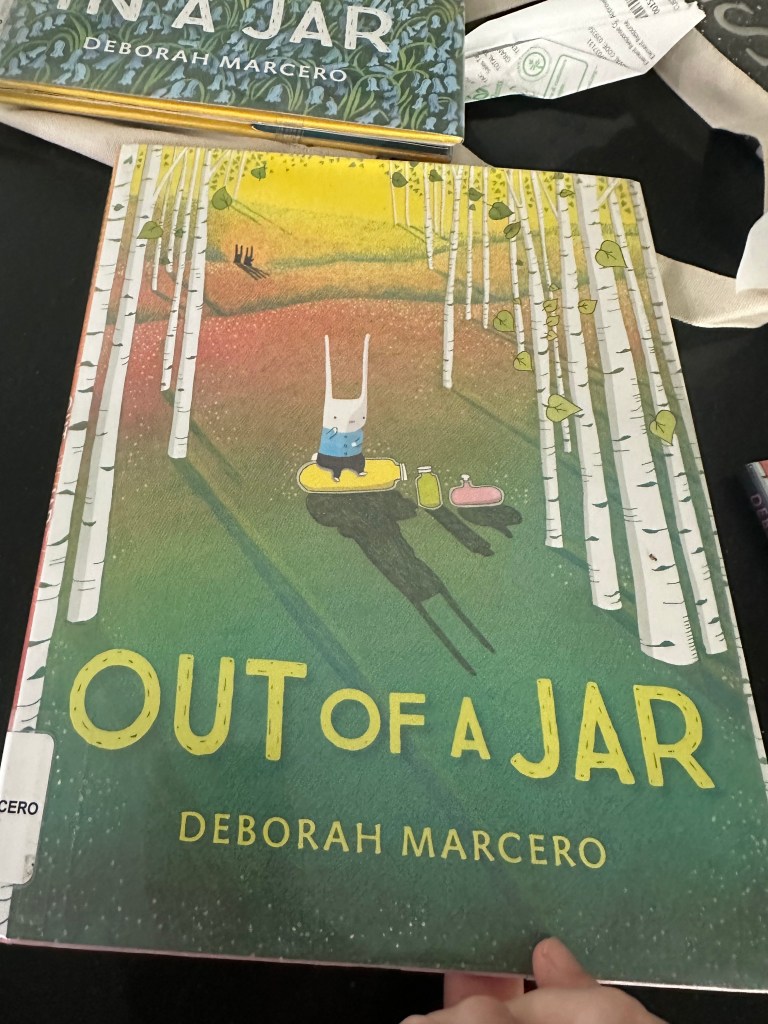
Published 2022
Medium: Watercolor, pencil, colored pencils, ink, digital media
Llewellyn returns in Marcero’s second book in the “Jar” series. This time Llewellyn’s emotions are overwhelming. He realizes he can trap them in jars. But what will happen when the glass jars strain with the stress of containing all these feelings?
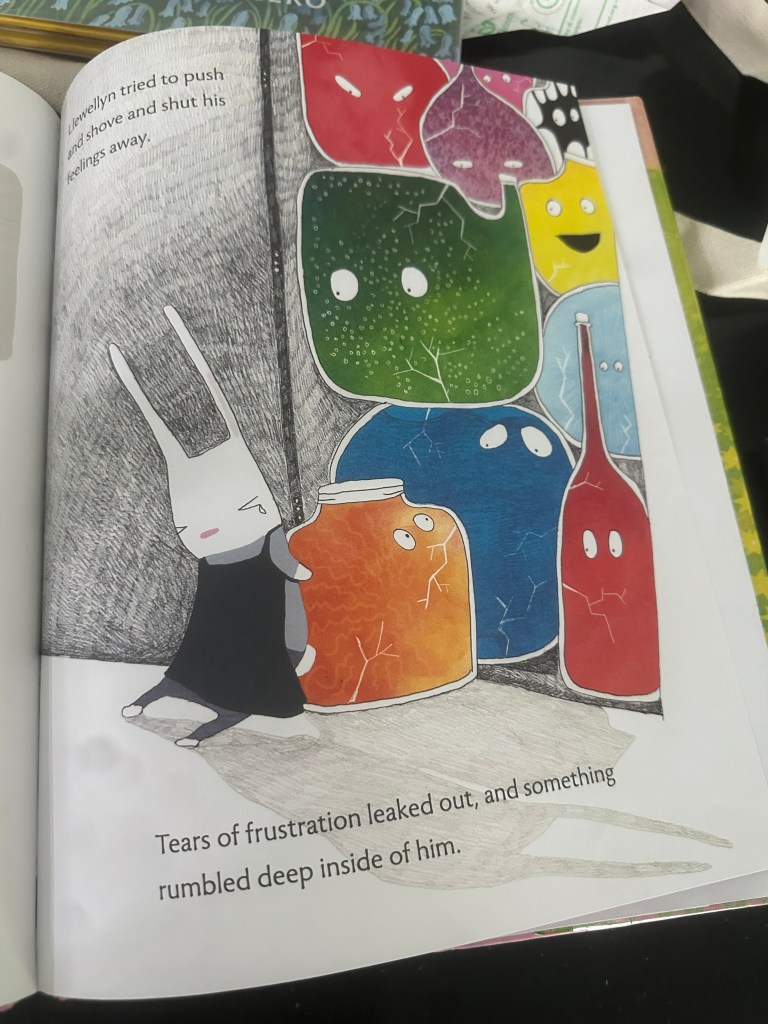
Marcero’s illustrations of the emotions as different colored splotchy shapes are a delight. The expressive eyes of the emotions convey a watchful curiosity that adds to the message of the book. Emotions are not good or bad. They need to be acknowledged before letting them go.
This book would be an excellent addition to any “calm down” rug or a reading circle on classroom norms. Students might enjoy expressing their own emotions as inky splotches. This would also be a great read aloud to kick off a sensory jar activity.
Hope in a Jar
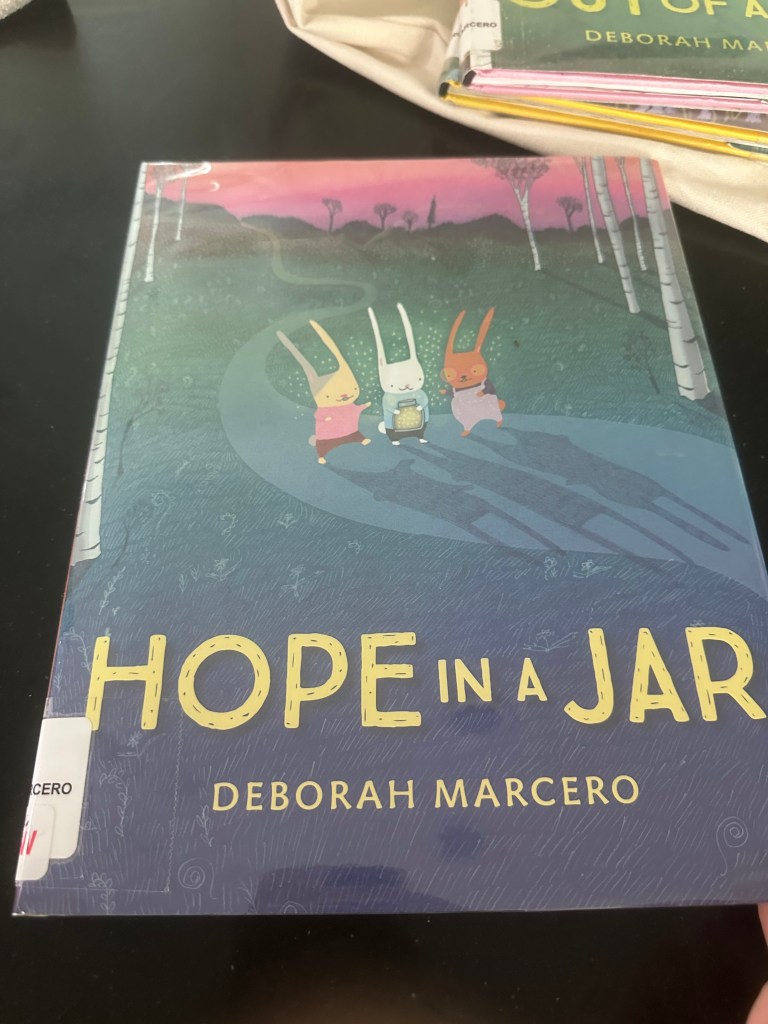
Published 2025
Medium: Watercolor, pencil, colored pencils, ink, digital media
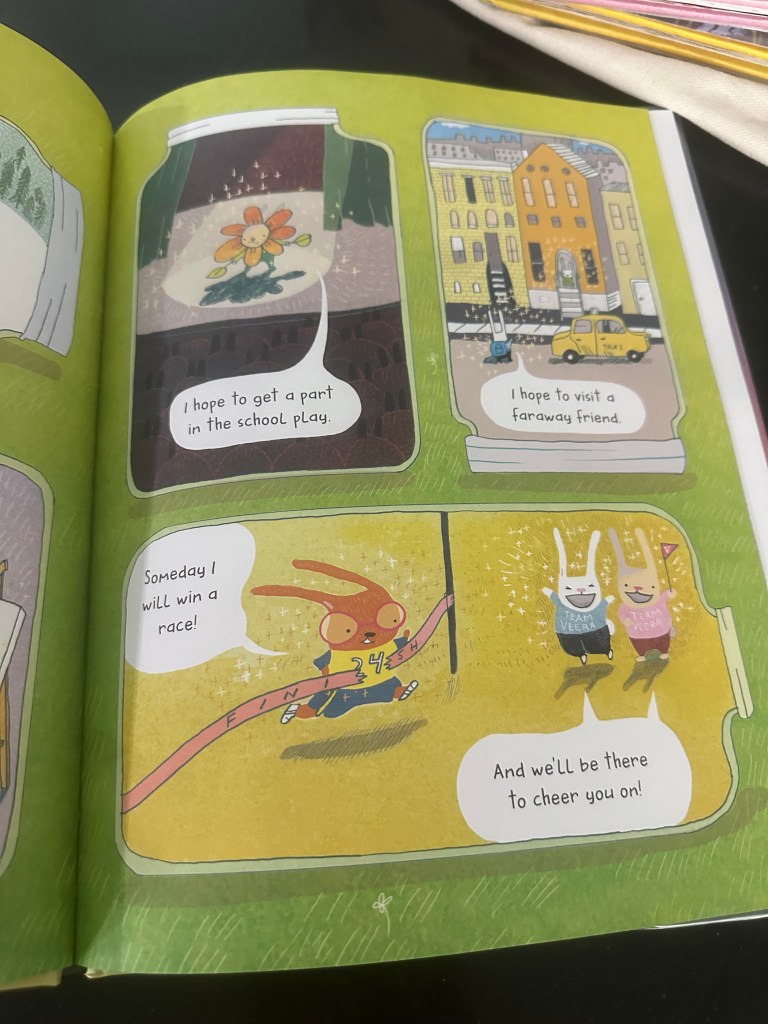
Llewellyn has used his jars to store special memories for savoring and to trap unruly emotions. In Hope in a Jar,Llewellyn and his friends use their jars to store their dreams for the future. All is well until a storm comes along and seems to destroy their dreams. With the help of hope, Llewellyn and company learn to begin again.
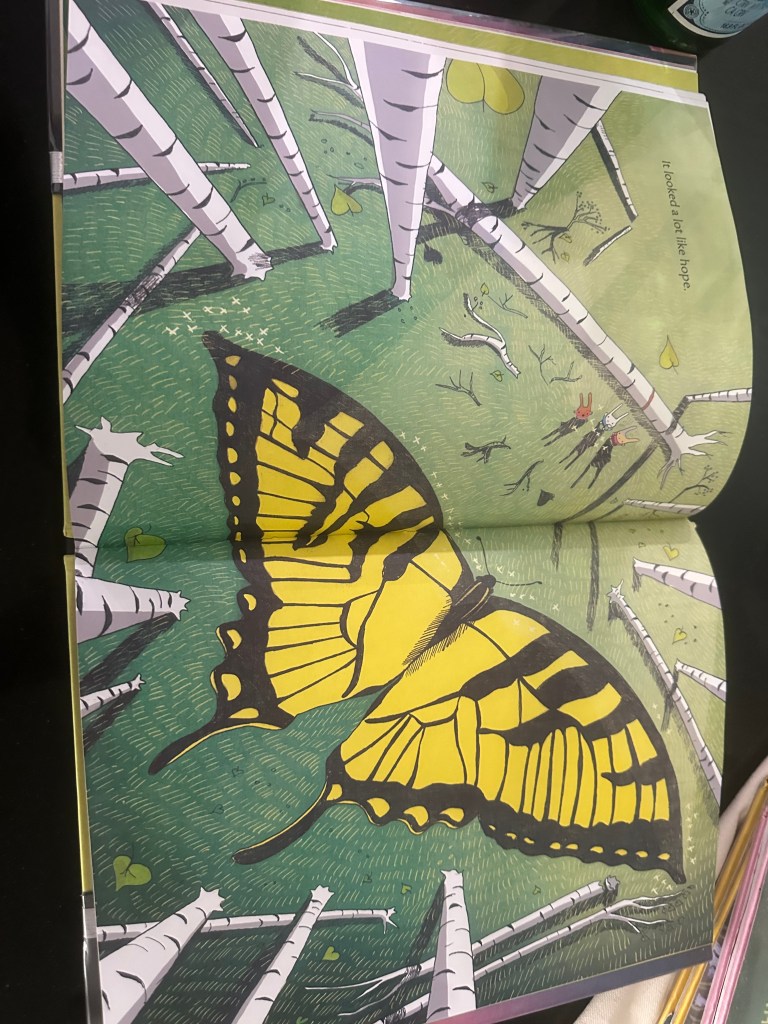
Educators could use this book to continue to explore the concept of a metaphor with students. A close look at Marcero’s butterfly is an exploration into the use of perspective and composition to convey emotion. Can you feel the character’s awe?
This book would be an excellent leaping off point for the Elementary School Academic and Career Plan Portfolio (ACPP) mandated by Virginia’s legislature. Students could use jar drawings or physical jars to store metaphorical representations of future dreams. This playful method allows students to explore their creativity while still “demonstrat[ing] goal setting.”
The Great Escape
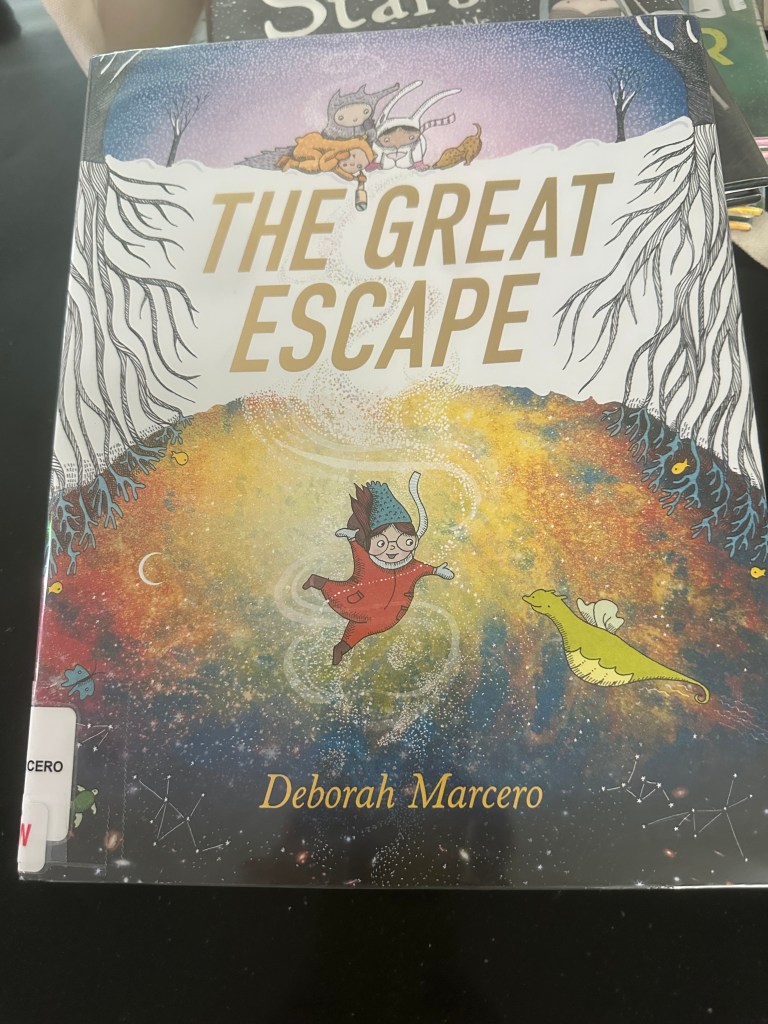
Published 2026
Medium: hot press watercolor paper, watercolor paints, archival ink pends, images from the James Webb Space Telescope, photoshop
In this incredible new work, Marcero plays with the picture book form to invite readers into a magical world with Evie. Evie is fed up with too much noise and too little personal space from her siblings. She treks outside in a winter wonderland to escape them. When they follow her outside, there’s only one thing left to do: disappear into the world beneath the snow.
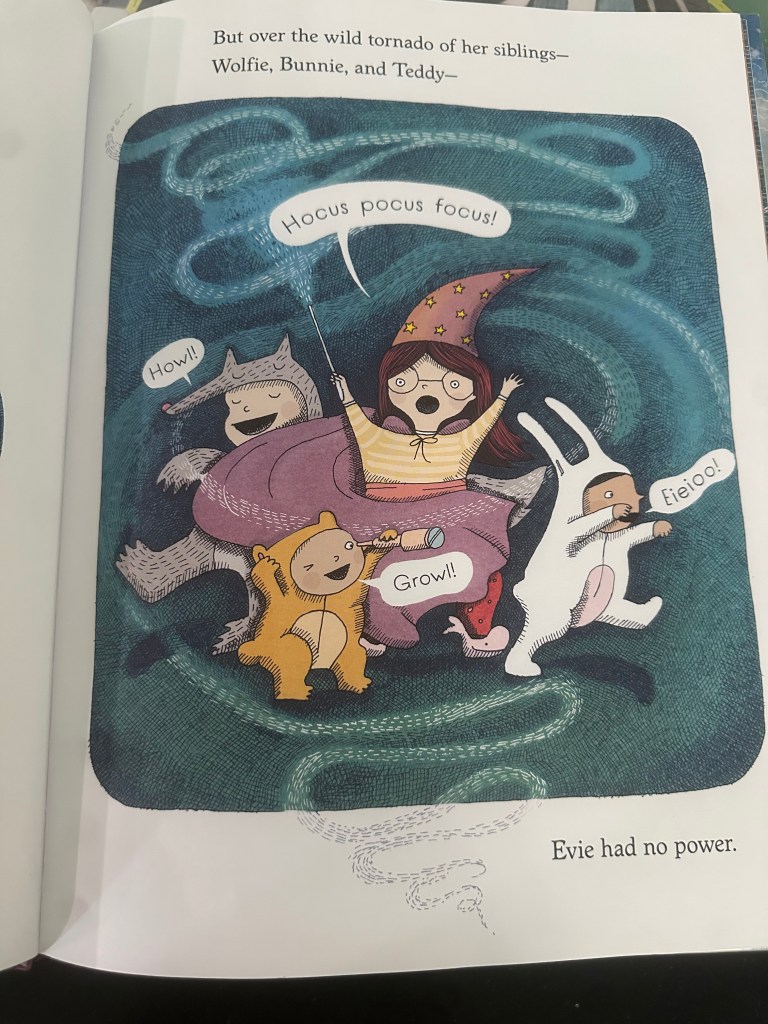
In the opening pages of the book Marcero departs from her full-page illustrations to use graphic novel style panels. The panel style conveys Evie’s feelings of being cramped and crowded. The book then takes a turn, literally, when readers are guided to flip the book upside down as Evie travels into an underground scene that combines space and the ocean. After some magical adventures with siblings, Marcero returns to the panel style illustrations, this time conveying coziness.
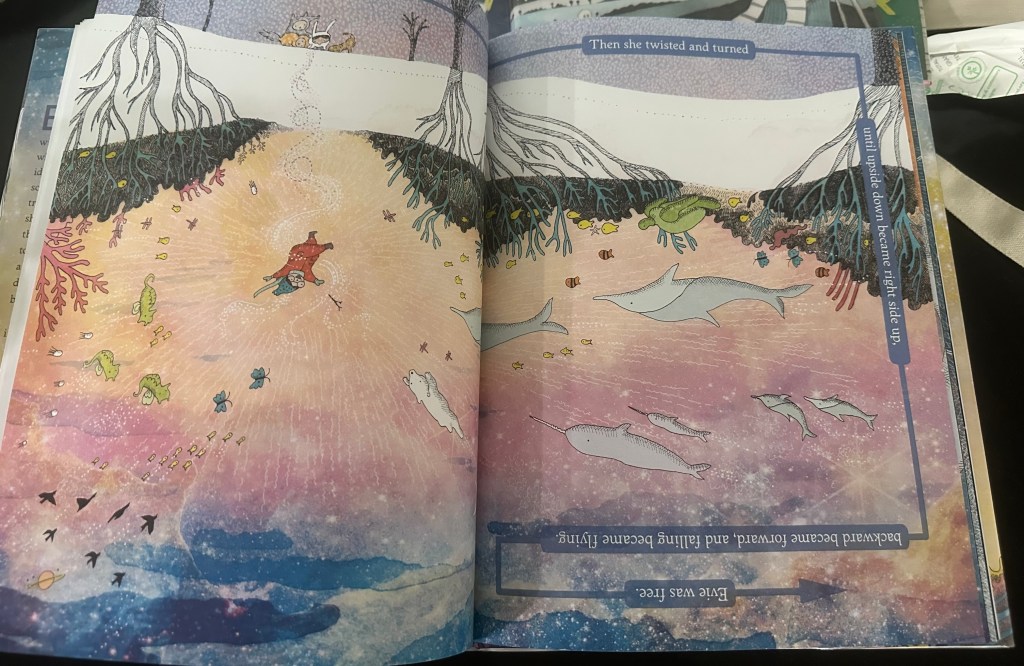
Add The Great Escape to a collection of meta-books (picture books about books, such as The Book With No Pictures or We are in a Book that play with the format of a book). This concept is akin to “breaking the fourth wall,” a literary technic often explored in high school, that can be introduced earlier.
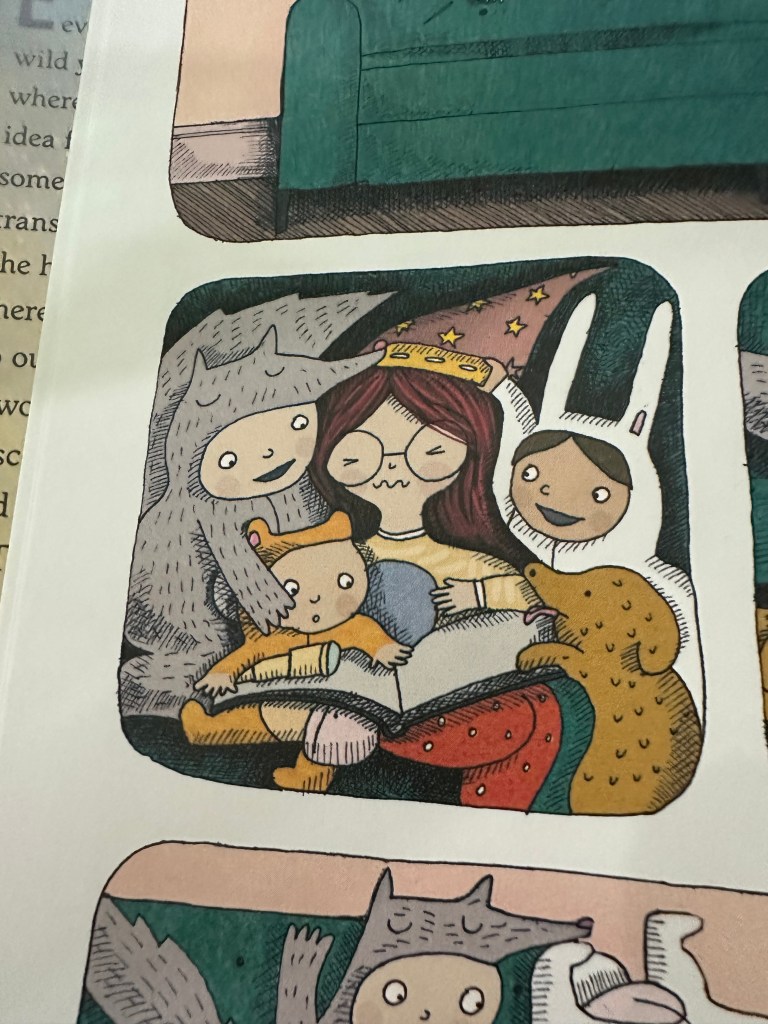
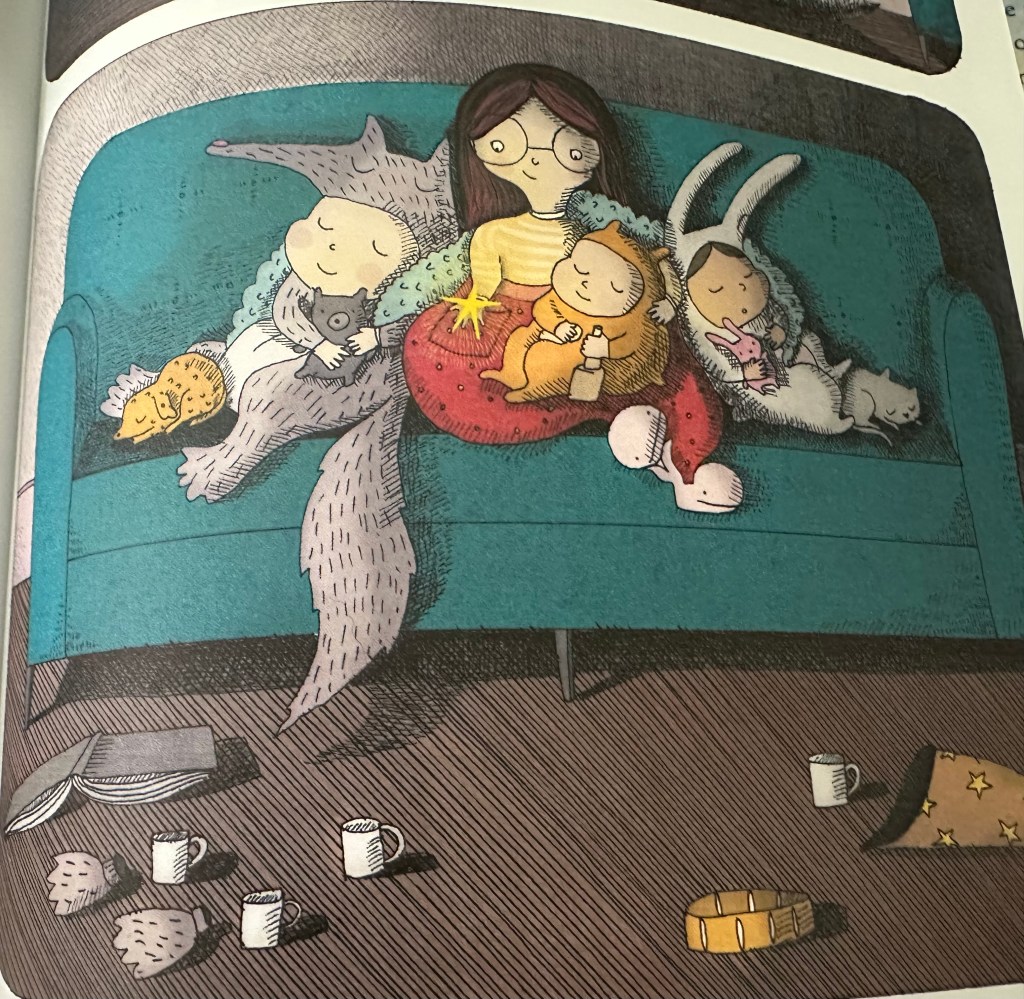
Educators could use the starting point of kids crammed together on the couch compared to the end image of kids snuggling on the same couch to explore the concept of “beginning, middle, end” in story telling. Before reading the book, students could be presented with the beginning image (crammed together) and the end image (snuggling together) and asked to imagine the middle. Upon a read aloud, Marcero’s incredibly imaginative middle will impress even the most creative story-teller.
Educator Corner
This section helps connect the ideas above with the Virginia Standards of Learning, the number (or letter for Kindergarten) prefix tells you the intended grade).
- Investigate the “about the author” section of books, as well as author websites. (K.FFR.1 D Identify the author & illustrator of a text and define the role of each)
- Write a letter to the author. (K.W.2. 1.W.2 Organization and Composition; 2.LU.2, 3.LU.2, 4.LU.2 Mechanics; 9.W.1. 10.W.1, 11.W.1, 12.W.1 Modes and Purposes for Writing).
- Explore texts that are conceptually related through an author study. (DSR.1 [For each grade] The student will build knowledge and comprehension skills from reading and listening to a range of texts.)
- Explore the interview format as a research source. (2.R.1, 3.R.1 Evaluation and Synthesis of Information)
- Compare informational texts through comparing professional book reviews with reader book reviews. (2.RI.3, 3.RI.3 Integration of Concepts. B. Compare and contrast the most important points presented by two texts on the same topic). Write your own book reviews, Organization and Composition (K-12)
- Classroom management: Create a read-aloud playlist and keep it ready to go for a calm corner experience for learners.
- Introduce the concept of observation as part of the scientific method through reading “In a Jar” and inviting students to collect observations in their own jars. (Scientific and Engineer Practices Standards of Learning, K-5)
- Introduce the concept of metaphor through studying the jars as metaphor on in In a Jar, Out of a Jar, Hope in a Jar, and The Great Escape. For older students, these books can be used as an introduction to the genre of magic realism. (RV.1 Vocabulary Development and Word Analysis, grades 6 – 8);
- Introduce letter writing and/or culture exchange after reading “In a Jar.” Connect with a sister city or use other pen pal opportunities to set up an exchange of “jars.” (K.W.2, 1.W.2 Organization and Composition; 2.LU.2, 3.LU.2, 4.LU.2 Mechanics; 9.W.1, 10.W.1, 11.W.1, 12.W.1 Modes and Purposes for Writing; Sister City activities could be used to explore geography and social studies concepts.)
- Introduce an information text, picture book biography, to students. Use Marcero’s questions in her illustrator note in The Boy Whose Head Was Filled with Stars as an example of the kinds of questions informational illustrators ask when working on their art. Ask students to come up with their own list of research questions using the who, what, where, why format to inform a work of art of their own. (Reading Informational Text (K-12); K.RI.1, 1.RI.1, 2.RI.1 Key Ideas and Confirming Details)
- Compare and contrast information texts and illustrations to fictional texts and illustrations. (2.RI.3, 3.RI.3 Integration of Concepts. B. Compare and contrast the most important points presented by two texts on the same topic)
- As part of space and space exploration units, read The Boy Whose Head Was Filled with Stars, as a lead-in to a Make a Telescope activity. (Earth and Space Systems, K-5)
- As part of space and space exploration units, read The Boy Whose Head Was Filled with Stars and The Great Escape. Explore NASA’s websites on the Hubble and James Webb Space Telescope. Examine the latest images from the James Webb Space Telescope and consider how they impacted Marcero’s illustrations. (Earth and Space Systems, K-5)
- Classroom Management: Read Out of the Jar to explore emotions. Create Sensory Jars as a tool for students to use to manage their emotions.
- Elementary School Academic and Career Plan Portfolio (ACPP): Read Hope in a Jar to begin the process of creating an Elementary School Academic and Career Plan Portfolio (ACPP) with a focus on goal setting through exploring how the characters set goals for themselves in the story. Ask students to create their own dream jars to plan for the future.
- Explore a collection of “meta-book” such as The Book with No Picture, We Are in a Book, and The Great Escape to learn more about print concepts and the role of the author and illustrator. Older students can explore the metaphorical concept of “the forth wall” and use such a collection to explore it. (K.FFR.1 D Identify the author & illustrator of a text and define the role of each; RV.1 Vocabulary Development and Word Analysis, grades 6 – 8)
- Explore the concept of “beginning, middle, end” by presenting the opening illustration of kids on the couch in The Great Escape and the closing illustration of kids on the couch. Ask learners to imagine and/or write the middle. Compare their word to the book after a read aloud. (K.RL.1 Key Ideas and Plot Details, K.W.1 Modes and Purposes for Writing)
 Rachel Vogus' Habits and Hobbies