Over on Instagram, I have been working on a project where I encourage people to create a Reading Autobiography by revisiting their Touchstone books. Both concepts come from Donalyn Miller. I learned about and completed elements of this activity (Part 1 and Part 2) in Prof LaGarde‘s Young Adults Literature & Reading class at Rutgers.
Today, I’d like to add a new part to this project: Connect to the Present. But before we get there, let’s review what’s covered in the first three parts.
If you take away only one thing from this activity, I’d like you to take away the pleasure of remembering good reads and maybe to re-experience some of the delight of those books.
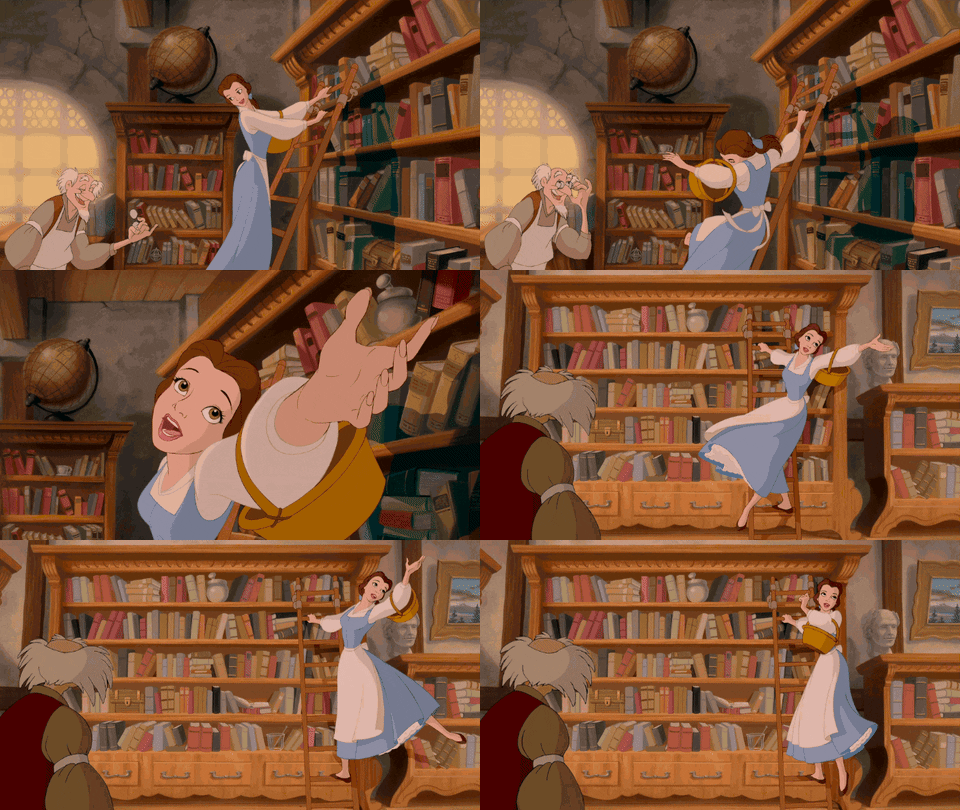
Part 1: Remember the Books
Remember books that had meaning to you growing up. Some people might characterize these as “books that change their life” or changed how they see themselves as a reader. It doesn’t always have to be like that. What’s the first book you can remember someone reading to you? Do you remember the first book you read on your own? Have you ever felt like a book was a friend? Did a book ever make you feel creative?
You can also include books that you hated. Was there a book that made you stop reading for awhile? Was there a time in your life where you thought of yourself a someone who didn’t like to read? What lead up to this? Reading autobiographies are the TRUE stories of our reading lives so include the good as well as the bad.
This is your list of touchstone books.
Part 2: Deepen Your Memories and Explore Themes
In this next part, you are going to go deeper into memories. Go on GoodReads, WorldCat, LibraryThing, your local library, or whatever your favorite site for books is. Look up as many of your touchstone books as you like. Try to find the cover that accompanied the edition you remember (many sites have “other editions” links). Does looking at the cover or the illustrations bring back other memories?
Try to collect the cover images all in one place (a digital document or physical document) or even just the titles of the book. Begin to think about if there are any themes that unite your touchstone books into a collection. Do the protagonists have anything in common? Do you like a certain type of conflict? Try to go deeper than genre. Think also about the circumstances of reading these books. How did you find these books? On your own? Recommendations? Where did you read them? Did you discuss them afterwards? Sometimes what unites our collection is our experience of reading.
Part 3: Revisit Your Memories to Add “Bad” Books
I must admit, this is my favorite part. Take a look at your collection. Perhaps you are like me and your first go around of touchstone books are all classics or parent-/teacher-approved. But the truth is that so-called bad books (books that teachers and parents sometimes scoff at) have a lot of meaning to us as readers. So let’s re-do Parts 1 and 2. This time, think about books you loved that were not teacher or parent approved. Were there comics that meant a lot to you? Pulp novels? Thrillers? Romances/erotica? Did you ever read any books that you had to hid from your parents? Were there books that all the kids in your class pass around to one another?
Another way to think about this is by emotion: What’s the scariest book you ever read? The funniest?
Part 4: Connect to the Present
Take what you know about your touchstone books and your reading autobiography. Can you imagine your perfect reading experience to recreate this now? Can you find other books that would fit in with your collection?
Today, I want to challenge to do this by selecting one of the books in your collection that would not meet your standards today. For example, although I will always love Little House in the Big Woods for the connection it created between me and my mom as she read it to me, I recognize that its presentation of Native Americans is outdated and racist. I can value my own relationship to the book and recognize and the way it connected me to my mom and also recognize that I want to read differently in the future.
In order to find the right book, think about the book you are hoping to replace on your list: Why did it have meaning for you at the time? What was happening when you were reading it? What was important about it to you?
In seeking an alternative to Little House in the Big Woods, I knew I was looking for a historical book that valued the inner life and perspective of a young girl. I wanted a book that depicted how even young girls have responsibilities and contribute meaningfully to their family. I knew, as well, that I wanted a book that married the life of a family to the rituals of nature. I found and enjoyed The Birchbark House by Louis Erdrich. Omakayas, a young girl in the “Ojibwa tribe, lives through the joys of summer and the perils of winter on an island in Lake Superior in 1847.” I’m also looking forward to trying Linda Sue Park’s Prairie Lotus. I am guessing I’m going to keep finding more and adding them to my list.
Your Turn
So now it’s your turn. Here’s a simplified list of questions to keep in mind.
- Which books, from the beginning of your reading experience, have the most meaning to you?
- What do these books or reading experiences share in common?
- What about “bad” books or so-called guilty pleasure books? Do any of them belong on your list?
- Can you use your knowledge of this collection of books to find new books for yourself? Can you use it to broaden your reading beyond books that may be outdated or that you want to let go of?
I always love hearing about touchstone books so please share what you uncover!
 Rachel Vogus' Habits and Hobbies