In Nov 2020, I wrote about the possibility of public libraries being used as vaccination sites and why librarians should be cautious about taking this challenge, in spite of the obvious ethical value of such an undertaking.
In that post, I argued that public libraries and librarians could take on important roles in vaccination distribution, ones that leveraged their expertise. Libraries could focus on helping patrons navigate privacy concerns with data collection. They could be on the front lines of addressing vaccination skepticism.
Now, as clinics pop-up in my own town in the parking lots of former Kmarts and empty mall store fronts, I realize I missed a very big role for librarians.
Librarians and libraries could step into the technological divide that is impacting vaccination distribution.
In her reporting “The Secret to Getting a Vaccine Appointment” Anne Helen Petersen writes about the experiences of family members trying to secure appointments for their elderly relatives and “navigat[ing] a Ticketmaster-like online system that stymies all but the most tech-savvy in order to do it.” She describes family members talking the elderly through the steps to scan an ID card or to use a trackpad to complete an electronic signature.

In other words, we are discovering, all over again, the inequalities created when we assume equal access to and knowledge of technology. You might assume that this inequalities will dissipate as we move into younger populations but that is not true. PEW Research’s Internet/Broadband Fact Sheet shows that not everyone has access to broadband internet at home, noting, “Racial minorities, older adults, rural residents, and those with lower levels of education and income are less likely to have broadband service at home.”
Consider those inequalities alongside the idea that libraries have long been used to fill in some of those gaps. In their 2016 report on library used, PEW Research reported, “29% of library-using Americans 16 and older said they had gone to libraries to use computers, the internet, or a public Wi-Fi network. (That amounts to 23% of all Americans ages 16 and above.)” and “Library users who take advantage of libraries’ computers and internet connections are more likely to be young, black, female, and lower income.”
Libraries and librarian have a long history with tackling unequal access to and knowledge of technology. In their Public Libraries and Community Access report, as part of the 2014 Digital Inclusion Survey, the ALA notes, “As the Internet became more widely used in the 1990s, public libraries embraced the role of providing access to and instruction for learning to use the Internet and current and emerging technologies.” In 2014, at the time of the report, about 98% of public libraries offered free WiFi and about 90% offered technology instruction.
Imagine if public libraries offered “vaccine sign-up clinics.” They could assist the general public in navigating the technology through virtual instruction. They could provide appointment for in-person assistance to navigate the sign-up system. The could set up outdoor stations within the reach of the libraries free Wi-Fi to allow users to access infrastructure they might not have at home. They could coordinate with local health departments to assist in redesigning Google forms and other sign up methods to be more user friendly.
There’s one huge caveat to this. The Executive Summary to the Public Library Funding & Technology Access Study 2011-2012, noted “ongoing budget woes…A majority of public libraries (56.7 percent) report flat or decreased budgets, a slight improvement from the 59.8 percent reported last year.” At the time, libraries also reported that they did not have enough computers to meet demand or fast enough internet.
And if you’re wondering what’s happening with the money right now or in the future, check out these findings from ALA’s survey “Libraries Respond: COVID-19 Survey Results (May 2020)“

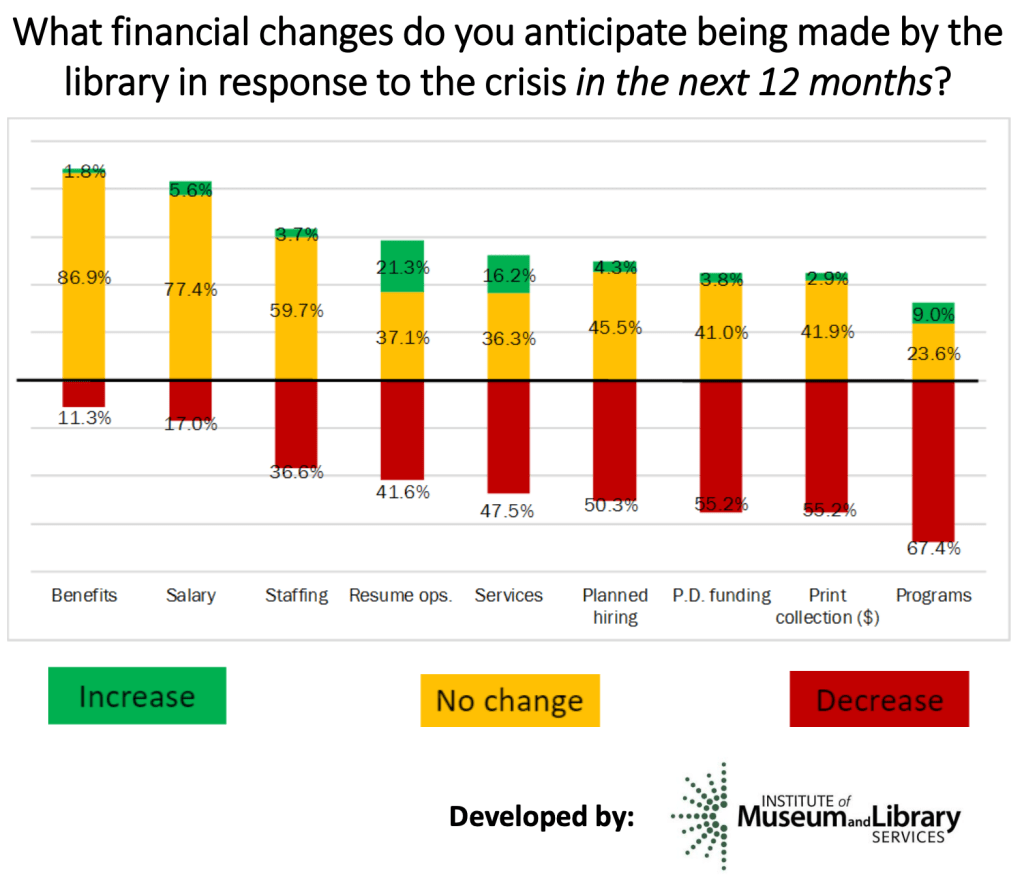
You are reading that right. Many libraries (over half of the respondents in some categories) are experiencing and anticipating decreased budget in a wide range of categories.
Take some time, as well, to read about what libraries have been doing during this time period.
Our libraries could help bridge the technology gaps that are slowing vaccination sign-up efforts. But first, we have to fund them.
 Rachel Vogus' Habits and Hobbies